
FLOW / DOSING / MEASUREMENT
Disinfection that responds to water flow.
Flow-proportional dosing combines dosing pumps, pulse water meters and injection equipment with suitable process measurement and operator support.
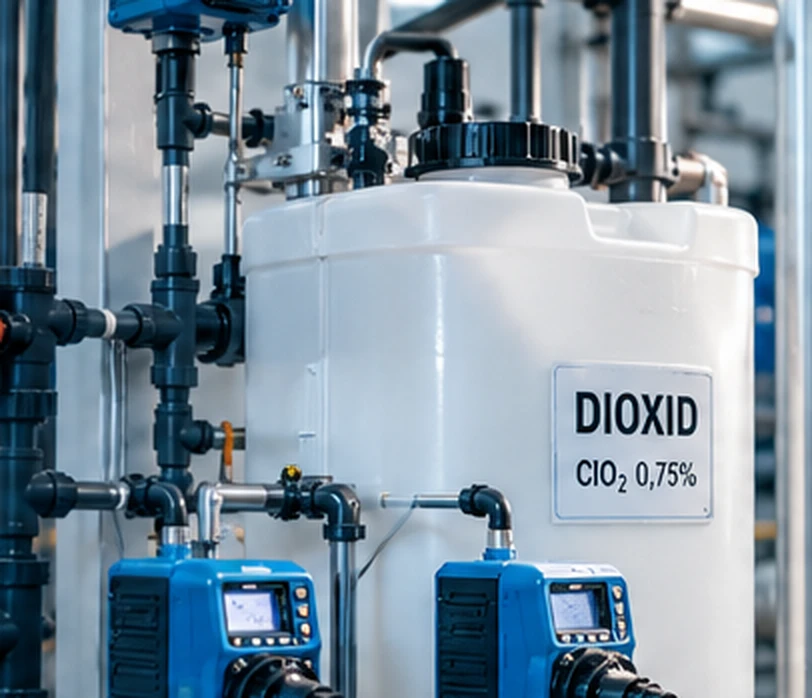 ILLUSTRATIVE IMAGE / DOSING ASSEMBLY
PROCESS LOGIC
From a pulse signal to controlled application.
A practical dosing system is more than a pump — each component must suit the installation. The pulse water meter provides information about the flow, and the metering pump adjusts the amount of solution. The calculation is no substitute for choosing the actual dose and validating it in the field.
- Water meter pulse
- Control signal
- Solution dosing
- Residual measurement
DIOXID / CALCULATOR
How does flow affect theoretical consumption?
Change the example values to explore the relationship between flow, target dose, product concentration and solution volume. The calculator uses a concentration of 7,500 mg/L ClO₂; the result is not a treatment recommendation.
Formula: amount of Dioxid SP 0.75% (L or L/h) = water volume (m³) or flow (m³/h) × 1000 × target dose (mg/L) ÷ 7,500 mg/L.
For illustration and preliminary arithmetic only. Not a treatment recommendation. Actual dosage depends on water demand, conditions, contact time, legal limits and measured residual; always follow the product authorisation and approved instructions.
COMPONENTS
Equipment selected for the process.
-
Pulse water meter
Provides flow-related pulses for proportional control.
-
Metering pump
Delivers disinfectant in response to the control signal.
-
Injection assembly
Introduces the solution into the process at a suitable point.
-
Measurement
Residual testing and process checks confirm operating conditions.
CONTACT / WELLTON
Have a water quality issue?
Let us start with the facts.
Describe your system, the issue and any available test results. We will help identify the next technical step.