
SURFACE HYGIENE / PT2 & PT4
Surface disinfection
as a defined, verifiable process.
Chlorine dioxide-based surface hygiene for suitable professional settings. We focus on how the active substance works, how a procedure is applied and how efficacy is documented.
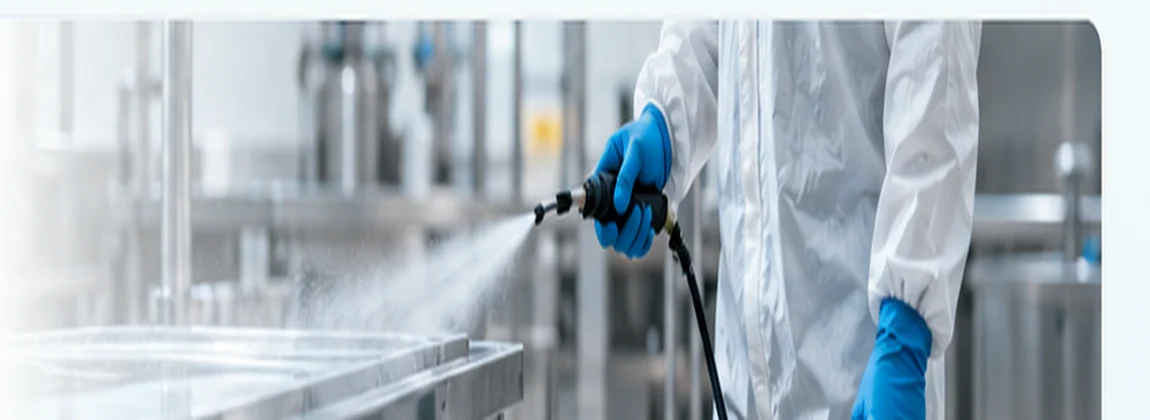 EQUIPMENT / PROCESS HYGIENE — ILLUSTRATIVE IMAGE
MECHANISM OF ACTION
Why chlorine dioxide?
Chlorine dioxide (ClO₂) is an oxidising disinfectant. Its antimicrobial action involves oxidative damage to important cellular structures and functions.
-
Contact with the microorganism
The active substance reaches the surface of the microorganism, provided that the treated surface has been properly prepared.
-
Oxidative action
Reactions with sensitive groups in proteins and other components can disrupt membrane integrity and cellular processes.
-
Inactivation
At a proven concentration and contact time, the number of target microorganisms is reduced, within the limits of the test results.
Efficacy depends on the microorganism, concentration, contact time, temperature, cleanliness and the nature of the surface. Claiming universal action without appropriate testing is not justified.
PRODUCT TYPES
PT2 and PT4: applications must match authorisation.
We distinguish product-type categories from the specific uses approved for each individual product. Final claims on the product label must comply with the product registration.
-
PT2
General surface hygiene
Disinfectants not intended for direct application to humans or animals, within the specific authorised uses and directions.
- Industrial and public spaces
- Work and auxiliary surfaces
- Equipment and furniture under approved conditions of use
-
PT4
Food and feed areas
Relevant surfaces and equipment in food/feed areas, only where covered by the specific product authorisation and label instructions.
- Food and beverage plants
- Surfaces and equipment in contact with food
- Defined hygiene procedures in production
Registration: registration details of the PT2 and PT4 product (decision number, approved uses and conditions of use) will be published after the original documentation has been checked. Contact us for information about the product.
PRACTICAL WORKFLOW
Designed for professional operators.
A practical procedure does not mean leaving out safety measures. The goal is a clear protocol that staff can carry out reliably.
-
Cleaning
Prepare the surface according to site and product requirements.
-
Application
Apply only in the authorised way, at the stated conditions and contact time.
-
Verification
Check the procedure and review relevant test evidence and records.
Dilution, protective equipment, contact time, rinsing of food-contact surfaces and other measures are determined solely by the instructions and the safety data sheet of the specific product.
EVIDENCE / EFFICACY TESTING
Efficacy confirmed by testing, not by slogans.
Relevant laboratory test reports should show which microorganisms the result applies to, which method was used for testing, and at what concentration and contact time.
On request, we provide the available technical documentation and efficacy test reports that accompany the relevant product.
What should the evidence include?
- Product name and tested formulation
- Reference method / standard
- Target microorganism and required reduction
- Concentration, contact time and test conditions
- Laboratory name and report date
Documents are not shown without verified originals.
FREQUENTLY ASKED QUESTIONS
Important before use.
Do PT2 and PT4 mean that a product is suitable for every surface?
No. PT2 and PT4 are product types, that is, categories of use. Follow the approved use, material compatibility, concentration, contact time and the instructions for the specific product.
Does chlorine dioxide replace prior cleaning?
No. Organic deposits and dirt can reduce the effect of disinfection. Preparing the surface is part of a correct protocol.
Is there evidence of efficacy?
What counts are reports that relate to the exact formulation and application. Contact us to review the existing test reports and supporting documentation.
CONTACT / WELLTON
Have a water quality issue?
Let us start with the facts.
Describe your system, the issue and any available test results. We will help identify the next technical step.